Chapter 2 Packet Available on Resources Page
2.1: Density Curves and Normal Distributions
Sometimes the overall pattern of a distribution is such that we can describe it with a smooth curve. It is remarkable how many natural phenomena appear to be related to a bell-shaped curve known as a normal distribution. When appropriate, using a normal distribution model to represent distributions that occur in real-life situations can be extremely useful in statistical analysis.
Density curve:
• Displays the overall pattern (shape) of a distribution. 
• Has an area of exactly 1 sq. unit underneath it. 
• Is on or above the horizontal axis. 
A histogram becomes a density curve if the scale is adjusted so that the total area of the bars is 1 sq. unit. The median of a density curve is the point that divides the area under the curve into halves. The mean of a density curve is the "balance point" of the curve.
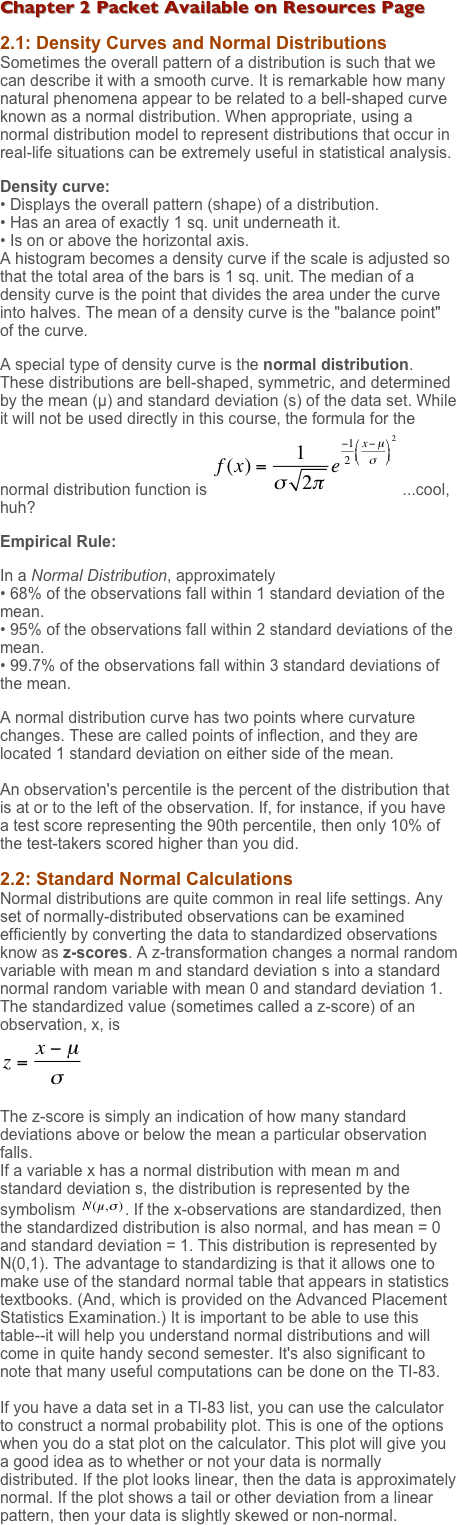
A special type of density curve is the normal distribution. These distributions are bell-shaped, symmetric, and determined by the mean (µ) and standard deviation (s) of the data set. While it will not be used directly in this course, the formula for the normal distribution function is ...cool, huh?
Empirical Rule:
In a Normal Distribution, approximately
• 68% of the observations fall within 1 standard deviation of the mean. 
• 95% of the observations fall within 2 standard deviations of the mean. 
• 99.7% of the observations fall within 3 standard deviations of the mean.
A normal distribution curve has two points where curvature changes. These are called points of inflection, and they are located 1 standard deviation on either side of the mean.

An observation's percentile is the percent of the distribution that is at or to the left of the observation. If, for instance, if you have a test score representing the 90th percentile, then only 10% of the test-takers scored higher than you did.
2.2: Standard Normal Calculations
Normal distributions are quite common in real life settings. Any set of normally-distributed observations can be examined efficiently by converting the data to standardized observations know as z-scores. A z-transformation changes a normal random variable with mean m and standard deviation s into a standard normal random variable with mean 0 and standard deviation 1.
The standardized value (sometimes called a z-score) of an observation, x, is
 
The z-score is simply an indication of how many standard deviations above or below the mean a particular observation falls.
If a variable x has a normal distribution with mean m and standard deviation s, the distribution is represented by the symbolism . If the x-observations are standardized, then the standardized distribution is also normal, and has mean = 0 and standard deviation = 1. This distribution is represented by N(0,1). The advantage to standardizing is that it allows one to make use of the standard normal table that appears in statistics textbooks. (And, which is provided on the Advanced Placement Statistics Examination.) It is important to be able to use this table--it will help you understand normal distributions and will come in quite handy second semester. It's also significant to note that many useful computations can be done on the TI-83. 

If you have a data set in a TI-83 list, you can use the calculator to construct a normal probability plot. This is one of the options when you do a stat plot on the calculator. This plot will give you a good idea as to whether or not your data is normally distributed. If the plot looks linear, then the data is approximately normal. If the plot shows a tail or other deviation from a linear pattern, then your data is slightly skewed or non-normal.

Chapter 2: The Normal Distributions

 
 
23_Chapter_3__Exploring_Bivariate_Data.html
    Previous
 

next >

Made on a Mac